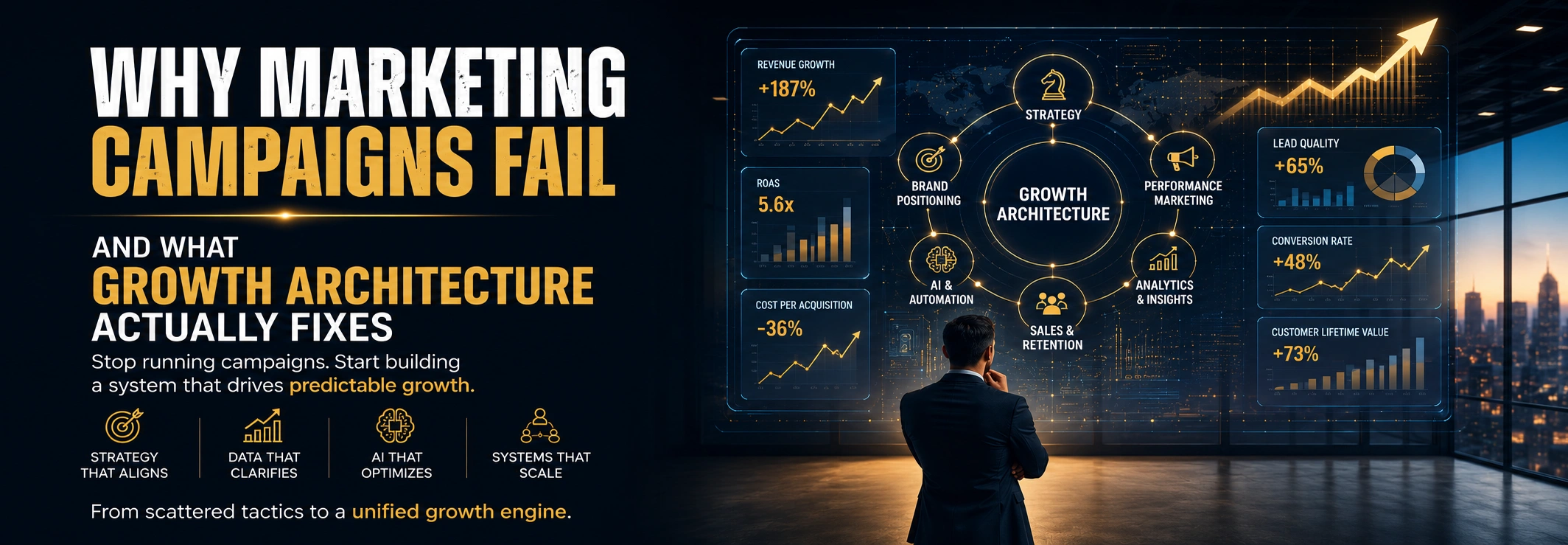
Every year, businesses invest billions of dollars in marketing campaigns with one common expectation—more customers, more revenue, and faster growth. Companies hire agencies, increase advertising budgets, redesign websites, invest in SEO, launch influencer campaigns, and embrace every new digital platform that promises results.
Yet, despite all these investments, a large percentage of marketing campaigns fail to deliver sustainable business growth.
The surprising reality is that marketing itself is rarely the problem.
The real issue lies much deeper.
Most organizations don't have a growth system.
They have disconnected marketing activities masquerading as a growth strategy.
A business may run Google Ads, optimize SEO, publish daily social media content, execute email campaigns, and even invest in AI-powered tools. But if these initiatives operate independently without a unified business objective, they generate activity—not predictable growth.
This is precisely where Growth Architecture creates a competitive advantage.
Rather than asking, "How do we generate more leads?", Growth Architecture asks a far more important question:
"How do we build a predictable revenue engine that continuously scales?"
That shift in thinking changes everything.
Marketing Isn't Broken. The System Is.
One of the biggest marketing mistakes businesses make is believing that increasing marketing efforts automatically leads to business growth.
It doesn't.
Imagine constructing a skyscraper without an architect.
You may have premium cement, the finest steel, experienced engineers, and unlimited resources. Yet without a blueprint connecting every component, the structure eventually becomes unstable.
Marketing works exactly the same way.
Businesses today often have multiple specialists working simultaneously:
- SEO teams focused on rankings
- Social media managers chasing engagement
- Paid advertising teams optimizing click-through rates
- Sales teams demanding better leads
- Leadership expecting higher revenue
Everyone is busy.
Everyone has dashboards.
Everyone has KPIs.
Yet no one is working from the same growth blueprint.
This lack of alignment creates fragmented customer experiences, inconsistent messaging, inefficient spending, and declining marketing ROI.
The result?
Businesses mistakenly conclude that marketing isn't working, when in reality, the underlying system is failing.
The Seven Reasons Marketing Campaigns Fail
1. No Clear Business Growth Strategy
One of the biggest reasons marketing campaigns fail is that businesses begin with channels instead of objectives.
Questions like:
- Should we advertise on Google?
- Should we invest in Meta Ads?
- Should we focus on LinkedIn?
are fundamentally the wrong questions.
Instead, leadership should first define:
- What business problem are we solving?
- Are we entering a new market?
- Are we increasing customer retention?
- Are we improving profitability?
- Are we launching a premium brand?
Marketing should always support business objectives—not replace them.
A strong business growth strategy ensures every campaign contributes toward measurable commercial outcomes rather than isolated marketing goals.
2. Measuring Leads Instead of Revenue
Generating thousands of leads sounds impressive.
But lead volume alone rarely determines success.
Imagine Company A generates 5,000 leads that convert at 1%.
Company B generates 500 leads that convert at 20%.
Which business grows faster?
The second.
High-growth companies measure success differently.
Instead of vanity metrics, they focus on:
- Customer Acquisition Cost (CAC)
- Customer Lifetime Value (CLV)
- Revenue per Customer
- Sales Velocity
- Return on Ad Spend (ROAS)
- Pipeline Quality
- Profit Margins
- Marketing ROI
A mature performance marketing strategy focuses on profitable customer acquisition—not just increasing lead numbers.
3. Marketing Channels Operate in Silos
Modern marketing consists of numerous moving parts:
- SEO
- Content Marketing
- Social Media
- Google Ads
- Meta Ads
- Email Marketing
- CRM
- Marketing Automation
- Analytics
- Sales
Unfortunately, many businesses treat each channel as an independent department.
SEO pursues rankings.
Paid media pursues clicks.
Content pursues engagement.
Sales pursues quotas.
None of these teams optimize the complete customer journey.
The most successful growth marketing strategies treat every channel as a connected ecosystem where each touchpoint strengthens the next.
The goal isn't better campaigns.
It's a better buying experience.
4. Weak Customer Journey
Many businesses invest heavily in traffic generation but overlook what happens after visitors arrive.
This is where significant revenue disappears.
Common conversion barriers include:
- Slow-loading websites
- Confusing navigation
- Weak landing pages
- Generic messaging
- Poor mobile experience
- Long forms
- Missing trust signals
- No follow-up automation
- Delayed sales responses
Businesses often assume the campaign failed.
In reality, customers abandoned the buying journey.
Growth Architecture recognizes that every click is only the beginning.
The real opportunity lies in designing frictionless customer experiences that maximize conversions at every stage.
5. No Data Intelligence
Data has become one of the world's most valuable business assets.
Yet many organizations still use analytics only for reporting rather than decision-making.
Most dashboards answer:
- How many clicks?
- How many impressions?
- How many visitors?
Far fewer answer:
- Which campaign generated the highest revenue?
- Which keyword acquired the most profitable customers?
- Which landing page delivered the strongest conversion rate?
- Which audience segment has the highest lifetime value?
- Which content influences purchase decisions?
Without actionable intelligence, marketing decisions become assumptions rather than informed strategies.
Businesses that leverage data effectively continuously improve customer acquisition while reducing waste.
6. Poor Brand Positioning
Marketing cannot compensate for weak positioning.
Consumers are exposed to thousands of marketing messages every day.
If your brand communicates exactly like every competitor, customers default to comparing prices.
Strong positioning changes the conversation.
Instead of competing on discounts, premium brands compete on trust, expertise, experience, innovation, and outcomes.
People don't buy products.
They buy confidence.
They buy credibility.
They buy certainty.
An effective good marketing strategy starts with defining why customers should choose your business over everyone else.
Only then should campaigns begin.
7. No Continuous Optimization
Markets evolve rapidly.
Consumer behavior changes.
Platforms update algorithms.
Competitors launch new products.
Customer expectations rise.
Yet many businesses launch campaigns and expect them to keep delivering results indefinitely.
Successful organizations never stop testing.
They continuously optimize:
- Headlines
- Offers
- Creatives
- Landing Pages
- Audience Segments
- Calls-to-Action
- Email Sequences
- Sales Scripts
- Pricing Models
- Customer Journeys
Continuous optimization transforms marketing from a one-time activity into an ongoing competitive advantage.
What Is Growth Architecture?
Growth Architecture is a strategic framework that aligns every customer acquisition and customer retention function into one integrated business system.
Rather than viewing marketing as a department, Growth Architecture views growth as an organizational capability.
Instead of asking,
"How do we generate more leads?"
Growth Architecture asks,
"How do we build a predictable engine that consistently generates revenue?"
This approach connects:
- Business Strategy
- Market Research
- Customer Insights
- Brand Positioning
- SEO
- Content Marketing
- Performance Marketing
- Conversion Rate Optimization
- AI Automation
- CRM
- Sales Enablement
- Customer Success
- Analytics
- Retention Marketing
- Referral Programs
Every function shares common goals, common data, and common accountability.
The result is sustainable, measurable growth.
A Better Marketing Framework
Many businesses think growth looks like this:
Google Ads → Leads → Sales
Unfortunately, customer behavior is far more complex.
Modern businesses require a complete ecosystem:
Brand Positioning
↓
Market Research
↓
SEO Strategy
↓
Content Marketing
↓
Performance Marketing
↓
Landing Page Optimization
↓
Lead Capture
↓
CRM Automation
↓
Sales Enablement
↓
Customer Experience
↓
Retention
↓
Upselling
↓
Referrals
↓
Recurring Revenue
↓
Long-Term Business Growth
Growth is not one campaign.
Growth is a system.
Why AI Is Changing Marketing Forever
Artificial Intelligence is fundamentally reshaping how businesses attract, convert, and retain customers.
Organizations that embrace AI gain significant advantages in speed, personalization, efficiency, and decision-making.
Today, AI enables businesses to:
- Predict customer behavior
- Score leads automatically
- Optimize advertising budgets in real time
- Generate personalized content
- Build intelligent customer journeys
- Improve search visibility
- Detect buying intent
- Forecast campaign performance
- Automate reporting
- Enhance customer support through AI assistants
However, AI is not a replacement for strategy.
It amplifies strategy.
Businesses with poor systems simply automate inefficiency.
Businesses with strong Growth Architecture scale faster than ever before.
The Shift from Marketing to Growth
Traditional marketing focuses on individual campaigns.
Growth-focused organizations think differently.
Instead of asking:
"How do we generate more website traffic?"
They ask:
"How do we increase qualified demand?"
Instead of asking:
"How do we increase followers?"
They ask:
"How do we increase customer lifetime value?"
Instead of asking:
"How many leads did we generate?"
They ask:
"How much predictable revenue did marketing influence?"
This mindset separates growing businesses from stagnant ones.
Signs Your Business Needs Growth Architecture
If several of these situations sound familiar, your organization may not have a marketing problem—it likely has a systems problem.
Ask yourself:
- Are different agencies working independently?
- Do marketing and sales blame each other?
- Are customer acquisition costs increasing?
- Are leads inconsistent every month?
- Do campaigns perform unpredictably?
- Are you unsure which channel actually drives revenue?
- Is reporting focused on clicks instead of business outcomes?
- Is customer retention declining?
- Does your CRM contain thousands of unqualified leads?
- Are your teams working hard but producing average results?
If you answered "Yes" to three or more questions, it's time to rethink your growth model.
Building a Predictable Growth Engine
Growth Architecture is not another marketing trend.
It is an operational philosophy.
It creates alignment between leadership, marketing, sales, technology, analytics, and customer experience.
The process begins with defining business objectives.
From there, every marketing investment is evaluated based on its contribution to revenue.
Instead of isolated campaigns, businesses create interconnected growth systems that continually learn, optimize, and improve.
Over time, this approach delivers:
- Lower acquisition costs
- Higher conversion rates
- Better customer experiences
- Increased customer retention
- Improved profitability
- Greater marketing accountability
- Stronger competitive positioning
- Predictable revenue growth
Rather than depending on occasional successful campaigns, businesses build engines that perform consistently regardless of market fluctuations.
Final Thoughts
Marketing campaigns will always remain an essential part of business growth.
But campaigns alone cannot create sustainable success.
The businesses that dominate the next decade won't necessarily spend the most on advertising.
They'll build the smartest systems.
Growth Architecture replaces fragmented tactics with connected strategy.
It aligns marketing, sales, technology, customer experience, and AI into one unified framework designed to produce measurable business outcomes.
Marketing campaigns come and go.
Platforms rise and fall.
Algorithms constantly change.
A well-designed growth system continues creating value regardless of those changes.
If your organization wants predictable revenue, stronger marketing ROI, lower acquisition costs, better customer experiences, and long-term competitive advantage, the answer isn't running more campaigns.
It's building a Growth Architecture that turns every marketing investment into a scalable business asset.
About the Author
Ashish Singh Somvanshi is a Growth Architect, entrepreneur, and digital transformation strategist with over 15 years of experience helping organizations across education, hospitality, healthcare, real estate, manufacturing, and enterprise sectors scale through AI-powered growth systems, performance marketing, digital transformation, and strategic business consulting.
Rather than focusing solely on campaigns, his work centers on designing predictable growth engines that connect strategy, technology, marketing, and customer experience to deliver measurable commercial outcomes and sustainable competitive advantage.
Ready to Build a Growth Engine Instead of Running Random Campaigns?
If your business is struggling with inconsistent leads, rising customer acquisition costs, disconnected marketing efforts, or declining ROI, it's time to move beyond isolated campaigns and build a growth system designed for long-term success.
Whether you're scaling a startup, expanding an enterprise, or transforming an established brand, Growth Architecture provides the strategic foundation needed to align marketing, sales, AI, technology, and customer experience into one measurable revenue engine.
Book a Growth Strategy Consultation today and discover how your business can shift from unpredictable campaigns to predictable growth.
Website: www.ashishsinghsomvanshi.com
Stay Connected
Want to stop guessing why your campaigns fail and start building marketing that actually works? Follow on Instagram for bite-sized breakdowns on growth architecture, campaign audits, and marketing frameworks that drive real results, and connect on LinkedIn for deeper conversations on fixing broken marketing systems, building scalable growth strategies, and turning ad spend into measurable business outcomes.