Artificial intelligence is transforming the way people work, innovate, communicate, and make everyday decisions. Businesses use artificial intelligence to improve productivity, analyse information, automate routine work, and understand customers.
Yet, as technology becomes more capable, one important question remains: will AI replace human expertise?
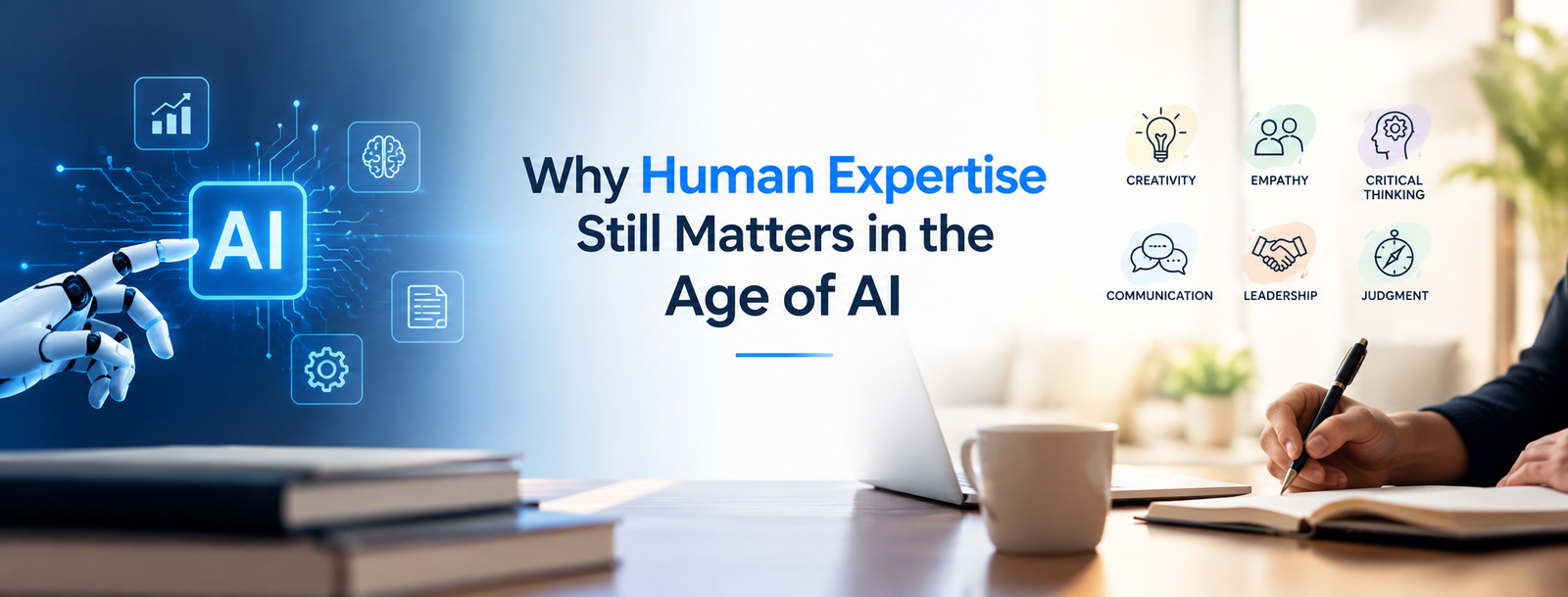
The real opportunity lies in understanding how AI and people can work together. AI can process information quickly, identify patterns, automate repetitive tasks, and generate content. Humans bring judgment, empathy, creativity, experience, critical thinking, and an understanding of context.
This is why AI and human expertise are becoming complementary rather than competing forces. The future will depend not only on adopting advanced technology but also on knowing how to combine it with the strengths of people.
Artificial Intelligence and Human Intelligence
Artificial intelligence is designed to process information, recognise patterns, generate outputs, and perform specific tasks. Modern systems can write text, create images, analyse data, and support workflows.
Human intelligence works differently. People understand emotions, relationships, social situations, cultural context, and consequences. Humans can question assumptions, learn from personal experience, and make decisions when there is no perfect answer.
For example, AI may analyse customer data and identify a trend. A business leader still needs to understand what that trend means for the organisation and how the company should respond. This difference makes human judgment especially important even when AI provides useful information.
Why Human Skills Still Matter in the Age of AI
The workplace is changing, but the importance of human skills is not disappearing. Communication, leadership, empathy, collaboration, negotiation, critical thinking, creativity, and problem-solving remain valuable because organisations are built around people.
These are among the skills AI cannot replace easily because they depend on context and human interaction.
For example, AI can suggest ways to improve employee productivity. A manager must still consider team morale, individual circumstances, company culture, and the possible effect of change on employees.
Human Experience Adds Context
Human experience helps professionals recognise situations that data alone may not explain. Experienced leaders often understand customer behaviour, workplace dynamics, and business challenges because they have encountered similar situations before.
AI can provide recommendations and possible scenarios. Human experience helps professionals decide whether those recommendations make sense in a particular situation.
How Does AI Impact Human Creativity?
AI has changed the creative process. Tools based on artificial intelligence can generate ideas, write drafts, create visuals, analyse trends, and explore different possibilities within seconds.
However, generating something is not the same as creating something meaningful. Human creativity provides originality, emotion, taste, context, and purpose.
A marketer can ask AI to generate campaign ideas, but a human decides which concept fits the brand and audience. A designer can explore AI-generated directions, but professional judgment shapes the final result.
AI Can Support Creativity
AI can become a creative assistant rather than a replacement. Professionals can use it to brainstorm, research, explore alternatives, and develop drafts.
This approach allows human creativity and AI innovation to work together while preserving originality and brand identity.
How Can Humans and AI Work Together?
AI is useful for speed, scale, automation, pattern recognition, and repetitive processing. Humans are valuable for strategy, creativity, communication, relationships, judgment, and accountability.
A practical workflow is simple: AI gathers information, humans review it, apply context, and make the final decision.
AI as a Business Copilot
AI can act as a business copilot rather than a replacement for employees. An executive can ask AI to summarise market research and then review the evidence, challenge assumptions, consider business priorities, and decide what action is appropriate.
Similarly, marketing teams can use AI to analyse campaign data while human professionals decide whether recommendations fit the brand, customers, and wider strategy.
Why Is Human Judgment Important for Decision Making?
Decision making often involves uncertainty. There may be incomplete information, competing priorities, ethical concerns, or consequences that cannot be predicted accurately.
AI can support decision making by presenting useful data and possible scenarios. However, professionals need to evaluate those outputs carefully.
They should ask whether the information is accurate, whether important context is missing, whether the recommendation fits the business objective, and whether the decision could create unintended consequences.
Human judgment provides clear accountability. This matters when AI is used for hiring, finance, education, or strategy.
AI Impact on the Future of Work
AI and the future of work are closely connected. Automation is changing how professionals perform many routine tasks, while new responsibilities are developing around AI implementation, oversight, strategy, and governance.
The important shift is that professionals will increasingly need to know how to work alongside AI. Employees may spend less time on repetitive information processing and more time on analysis, communication, problem-solving, and strategic work.
Human Skills in the Future Workplace
The workplace of the future will require both technological awareness and strong human skills. Professionals may need critical thinking, communication, creativity, leadership, emotional intelligence, collaboration, and strategic thinking.
Continuous learning will remain important as AI capabilities develop.
AI Technology Trends and Digital Business
Current AI technology trends are influencing digital business across industries. Generative AI, automation, AI-powered analytics, intelligent assistants, and personalised customer experiences are becoming part of modern business operations.
For companies, adopting AI is both a technology and strategic decision.
AI and Digital Strategy
A successful digital strategy should connect AI adoption with measurable business objectives. For example, a company may use AI to improve customer support. But simply installing an AI chatbot does not guarantee better customer experiences.
Businesses need to determine which questions can be automated, when customers should reach a human employee, and how feedback can improve the service.
This is where human intelligence and technology need to work together.
AI Innovation Needs Human Creativity
AI innovation creates new possibilities, but innovation still requires human ideas. AI can identify patterns, generate possibilities, and process research. Humans identify meaningful problems and decide which opportunities are worth pursuing.
For example, AI may identify changing customer preferences. A human team can use those insights to develop a service, improve a product, or rethink the customer journey.
Technology creates possibilities. People provide clear direction.
What Is the Future of AI?
The future of AI will involve deeper collaboration between people and intelligent systems. AI will continue to become part of software, marketing, operations, research, customer service, and decision-support systems.
As this happens, professionals will need to understand both the capabilities and limitations of AI.
The future of artificial intelligence is therefore not only about making machines more capable. It is also about helping people use those capabilities responsibly and effectively.
What Skills Can AI Not Replace?
The question of skills AI cannot replace is not fixed because technology continues to evolve. However, abilities involving empathy, relationship building, leadership, complex judgment, negotiation, ethical reasoning, and genuine human experience remain difficult to automate completely.
A machine can analyse a customer complaint. A skilled employee can understand the emotion behind it and decide how to rebuild trust.
Why Businesses Still Need Human Expertise
Businesses operate in environments that are unpredictable and human-centred. Customers have emotions. Employees have individual needs. Markets change. Competitors respond unexpectedly. Partnerships depend on trust. Leaders must make difficult choices with incomplete information.
AI can support these processes, but human expertise remains necessary to interpret information and manage real consequences.
For digital business leaders, the practical question is not whether AI should replace people. It is how AI can strengthen the expertise already available within an organisation.
Conclusion
Artificial intelligence is transforming work, business, and creativity, but human expertise still matters in the age of AI.
The AI vs human debate misses a bigger opportunity. AI and people have different strengths, and those strengths can complement one another. AI provides speed, automation, data processing, pattern recognition, and scalability. Humans provide experience, judgment, empathy, creativity, communication, and accountability.
The strongest model is genuinely collaborative.
When AI and human expertise work together, businesses can use technology while retaining the human thinking needed to make responsible and meaningful decisions.
As AI trends continue to evolve, organisations should focus not only on adopting new technology but also on developing the people who use it. The future of artificial intelligence is ultimately also about the future of human work.