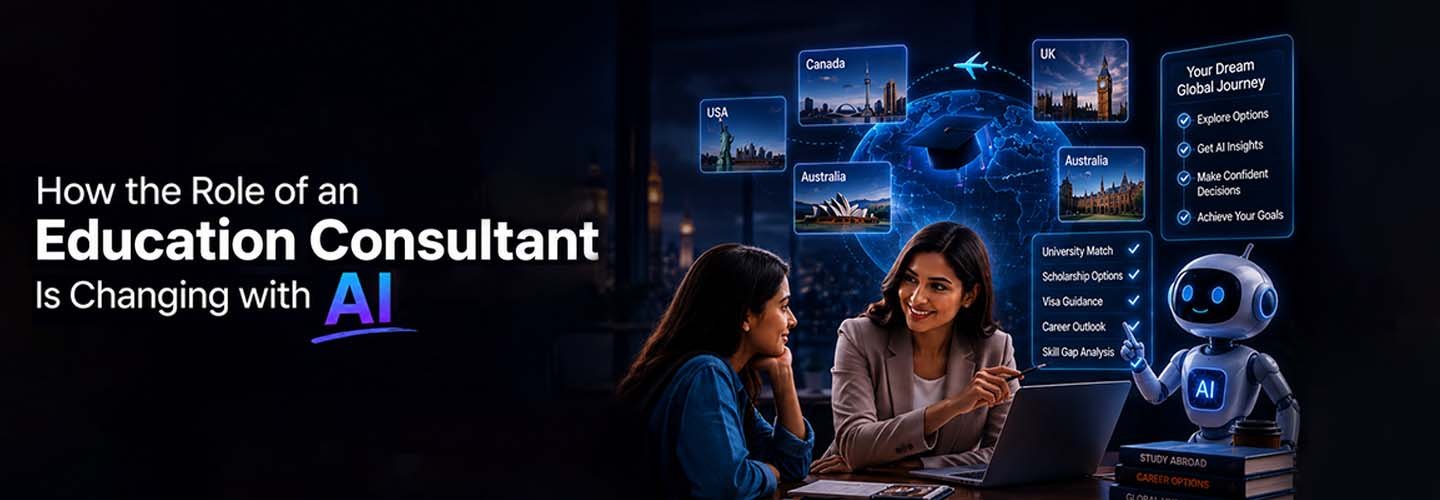
The education sector is changing rapidly. Students and parents today have more choices than ever before. There are hundreds of courses, universities, countries, entrance exams, scholarships, online programs, hybrid learning options and career paths to consider.
This has made decision-making more complex. A student may ask:
- Which career path is right for me?
- Should I study in India or abroad?
- Which university will give me better exposure?
- Is this course future-ready?
- Will this degree help me get a good job?
- How do I prepare for a changing job market?
This is where education consultants continue to play an important role. They help students and parents make sense of information, compare options and take decisions with confidence.
But with artificial intelligence now entering every part of education, the role of an education consultant is also changing. AI tools can now compare universities, suggest career paths, analyse student profiles, track applications and even recommend scholarships. This raises an important question:
Will AI replace education consultants?
The answer is no. AI will not replace good education consultants. But it will definitely change the way they work.
The Traditional Role of an Education Consultant
Education consultants have always been more than just advisors. For many students and parents, they act as trusted guides during one of the most important phases of life.Their role usually includes helping students understand career options, select courses, shortlist universities, prepare applications, understand admission requirements and make final decisions.
But beyond the technical process, consultants also provide emotional support. Many students feel confused, pressured or unsure about their future. Parents are often worried about investment, safety, career outcomes and long-term stability.
A good education consultant helps both sides find clarity.Traditionally, consultants have played three major roles.
1. Clarity Providers
Students today face information overload. Every university claims to be the best. Every course promises career growth. Every country looks attractive online. Social media, advertisements and rankings make the decision even more confusing.
Education consultants help students cut through this noise. They simplify information and explain what actually matters: course relevance, university credibility, career outcomes, location, budget, eligibility, admission process and long-term fit.
For example, a student interested in business may be confused between BBA, B.Com, BMS, integrated MBA, international business or entrepreneurship programs. A consultant can help the student understand the difference and choose based on their aptitude, personality and career goal.
2. Career Shapers
An education consultant does not only help with admission. A good consultant helps shape the student’s career direction. This means understanding the student’s strengths, interests, academic background, communication skills, family expectations and future opportunities.
For example, two students may both want to pursue management. One may be better suited for marketing and brand roles, while the other may be more comfortable with finance, analytics or operations. A consultant can identify these differences through conversations and guide them accordingly.
This personal understanding is where human guidance becomes very important.
3. Emotional Anchors
Education decisions are emotional. Students may feel nervous. Parents may feel anxious. Families may disagree. Financial decisions may create pressure. Moving to another city or country can feel overwhelming.
In such situations, consultants often become emotional anchors. They reassure families, answer repeated questions, explain risks honestly and help students feel confident about the next step.
AI may provide data, but reassurance still comes from a human being who listens, understands and responds with empathy.
How AI Is Entering Education Consulting
Artificial intelligence is already changing how students search for education options.
Students are asking AI tools to suggest courses, compare universities, explain career options, prepare statements of purpose, find scholarships and understand future job roles.
AI can process large amounts of information quickly. It can analyse student profiles, compare admission criteria and provide structured recommendations within seconds.
Some areas where AI is becoming useful include:
- Career Assessment
- University Comparison
- Course Recommendation
- Scholarship Matching
- Application Tracking
- Document Review
- SOP and Essay Support
- Visa Checklist Support
- Admission Deadline Reminders
- Student Communication Automation
- Lead Management for Consultants
- Predictive Admission Insights
This means a large part of repetitive and data-heavy work can now be supported by AI.
What AI Can Do Better Than Humans
AI is useful where speed, structure and data processing are required. For example, AI can compare multiple universities based on fees, location, ranking, eligibility, course duration and intake. It can create checklists, track deadlines and organise student information.
AI can also help consultants respond faster to common student queries. Instead of manually answering the same questions again and again, consultants can use AI-supported systems to provide quick and consistent information. For education businesses, AI can also improve lead management. It can help identify serious students, segment enquiries, automate follow-ups and analyse which campaigns are bringing better quality leads.
This makes the consulting process more efficient.
What AI Cannot Replace
AI can provide information, but it cannot fully understand human context.
A student may technically be eligible for a course, but may not be emotionally ready to move abroad. A university may look good on paper, but may not suit the student’s personality. A career path may have demand, but may not match the student’s strengths. These are areas where human consultants matter.
AI cannot fully understand:
- Family Pressure
- Financial Hesitation
- Confidence Issues
- Emotional Readiness
- Communication Ability
- Cultural Fit
- Personal Motivation
- Long-Term Mindset
- Parent-Student Dynamics
- Unspoken Doubts
For example, AI may suggest a university based on ranking and course fit. But a consultant may realise during conversation that the student is not comfortable living far from home or may need a more supportive academic environment.
This kind of understanding comes from human interaction.
The New Role of an Education Consultant
The role of an education consultant is moving from information provider to strategic guide.
Earlier, students needed consultants because information was difficult to find. Today, information is available everywhere. The problem is not lack of information. The problem is confusion. This means consultants now need to help students interpret information, not just provide it.
The modern education consultant needs to become:
- A Career Strategist
- A Profile Mentor
- A Decision Coach
- A Parent Counsellor
- A Technology-Enabled Advisor
- A Future-Readiness Guide
This is a major shift.
From Advisor to Strategic Life Coach
In the future, education consultants will need to guide students not only for admission, but for life decisions connected to education and career.
They will need to help students understand:
- What Kind of Career Suits Them
- Which Skills They Should Build
- Which Industries Are Growing
- How AI May Affect Future Jobs
- Which Course Has Long-Term Relevance
- How to Build a Strong Profile
- How to Prepare for Interviews
- How to Communicate Better
- How to Make Confident Decisions
This makes the consultant’s role more meaningful.
A consultant who only shares college brochures may become less relevant. But a consultant who combines data, empathy, experience and career foresight will become more valuable.
AI Will Make Good Consultants Stronger
AI will not reduce the value of good consultants. It will make them more powerful. A consultant using AI can research faster, compare options better, prepare personalised student plans, automate follow-ups and manage more students with better accuracy.
For example, instead of spending hours manually comparing universities, a consultant can use AI tools to create a first-level comparison. Then the consultant can use experience and judgement to explain which option is actually best for the student.
This saves time and improves quality. The best results will come when AI handles the data and the consultant handles the decision-making conversation.
How Consultants Can Use AI Practically
Education consultants can start using AI in simple but useful ways.
They can use AI to prepare university comparison sheets, course summaries, student profile analysis, SOP outlines, interview preparation questions and follow-up messages.
They can also use AI to create better content for students and parents. For example, they can publish blogs, videos and FAQs around common questions such as:
- Which Course Is Better After 12th?
- How to Choose the Right MBA?
- Is Studying Abroad Worth It?
- Which Skills Are Important for Future Careers?
- How to Select the Right University?
- What Documents Are Needed for Admission?
This helps consultants build trust and attract better quality enquiries.
AI and Student Counselling
AI can support counselling, but it cannot replace the counselling experience.
In a counselling session, the real value often comes from asking the right questions. A student may say they want to study abroad, but the consultant needs to understand why. Is it for career growth, family influence, peer pressure, lifestyle, better exposure or migration opportunities?
AI may help organise answers, but the consultant needs to read the student’s mindset.
For example, a student may appear confident but may actually be confused. A parent may ask about fees but may actually be worried about safety. A consultant understands these layers through conversation.
This is why human counselling will remain important.
AI and Parent Communication
Parents play a major role in education decisions, especially in India. They want clarity on fees, return on investment, safety, reputation, career scope and future stability. AI can provide information, but parents often need personal reassurance.
A consultant can explain the practical side of a decision. They can help parents understand why a particular course or university is suitable for their child.
This trust cannot be built through automation alone.
AI and Career Readiness
The future of work is changing. Many jobs are being reshaped by technology, automation and AI. This means education consultants must also guide students on future skills. They should not only talk about degrees, but also about employability.
Students need to understand the importance of communication skills, digital skills, analytical thinking, problem-solving, leadership, adaptability and industry exposure. Consultants who can connect education choices with career readiness will have a stronger role in the future.
What Students and Parents Should Look For
Students and parents should not choose a consultant only because they provide university options. They should look for someone who gives personalised guidance.
A good education consultant should:
- Understand the Student’s Goals
- Explain Options Clearly
- Discuss Pros and Cons Honestly
- Use Data but Not Depend Only on Data
- Communicate with Parents Properly
- Guide Students Beyond Admission
- Help with Career Clarity
- Use Technology for Better Planning
- Provide Emotional Support During the Process
The right consultant should make the decision easier, not more confusing.
Challenges for Education Consultants
AI will also create challenges for consultants. Students may come with AI-generated information and expect deeper answers. Parents may compare recommendations online. Generic counselling may no longer be enough.
Consultants will need to upgrade themselves. They will need to understand AI tools, digital platforms, changing career trends, new-age courses and global education patterns. They will also need to build stronger personal brands. Trust, expertise and communication will become more important than ever.
The Future Belongs to Hybrid Consultants
The future of education consulting belongs to professionals who can combine technology with human understanding.
AI can support the process. It can improve speed, accuracy and organisation. But the final decision still requires emotional intelligence, experience and trust. The best consultants will be those who use AI for research and efficiency, but use human judgement for guidance and decision-making.
This is the new model of education consulting: data plus empathy, automation plus personal connection, technology plus trust.
Conclusion
The role of an education consultant is not disappearing. It is evolving.
AI will take over many data-heavy and repetitive tasks such as university comparisons, scholarship matching, application tracking and basic query handling. But human consultants will continue to play a key role in understanding students, guiding parents, building confidence and helping families make life-changing education decisions.
AI can tell a student which university matches their profile. But only a consultant can understand hesitation, family expectations, emotional readiness and long-term dreams. The future belongs to education consultants who are ready to adapt. Those who embrace AI while strengthening their human touch will become more relevant, not less.
Education consulting is no longer just about giving advice. It is about becoming a strategic life coach for students and families.