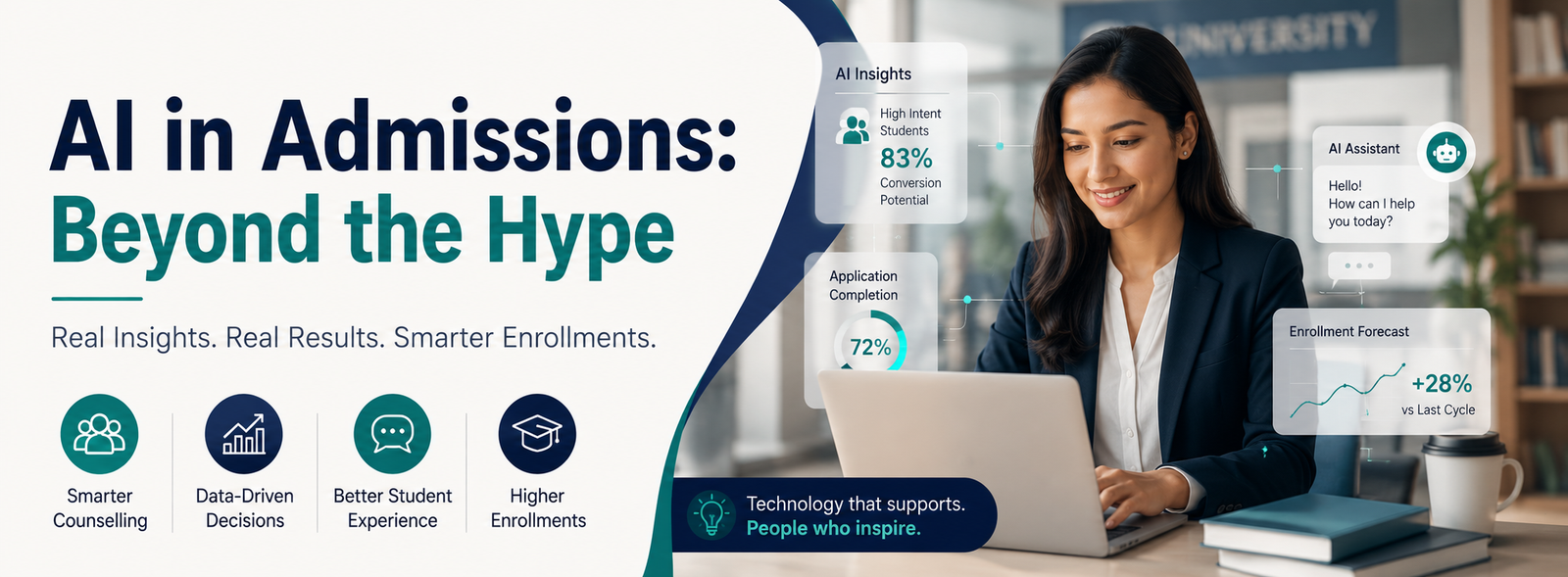
Is Artificial Intelligence Really Increasing Student Admissions, or Is It Just Another Buzzword?
Walk into almost any university boardroom today and you are likely to hear the same sentence:
“We need AI.”But ask the next question—why?—and the answer often becomes considerably less clear.
Some institutions want an AI chatbot because a competing university launched one. Others are experimenting with an admission predictor because predictive analytics sounds innovative. Marketing teams want AI-generated campaigns. Admissions departments expect artificial intelligence to reduce counsellor workload, improve application numbers and somehow increase enrollments.
The enthusiasm around AI in higher education is understandable.
Student expectations have changed dramatically.
Prospective students no longer wait until office hours to ask questions. They compare several universities before speaking to a counsellor. They expect instant responses, personalised recommendations and a seamless digital experience from the first advertisement they click to the moment they pay their admission fee.
But this is where an important distinction needs to be made.
Most universities don't actually have an AI problem.
They have an admissions-processproblem.
If enquiry data is scattered across spreadsheets, counsellors aren't following up consistently, CRM records are incomplete, applications are difficult to complete or nobody understands why students are dropping out of the funnel, introducing artificial intelligence doesn't automatically solve those problems.
It can simply automate inefficiency.
This is one of the biggest misconceptions surrounding AI for higher education.
Universities sometimes invest in technology before identifying the actual bottleneck. They purchase sophisticated platforms hoping AI will increase admissions, when the real issue may be slow response times, weak lead qualification, inconsistent counselling, poor follow-ups or inadequate visibility into student behaviour.
Artificial intelligence is not a replacement for an effective admissions strategy.
It is an accelerator for one.
The institutions likely to generate the strongest outcomes from AI technology in education are not necessarily those deploying the most sophisticated systems. They are the ones identifying very specific operational problems and using AI to improve them.
That may mean helping counsellors respond faster, prioritising high-intent applicants, automating repetitive administrative work, analysing student analytics, or personalising communication without removing the human connection students still expect during one of the most important decisions of their lives.
Because choosing a university isn't the same as ordering food online.
Students are making decisions involving their careers, finances, families and futures. Parents are involved. Employers can influence executive-education choices. Scholarships, location, reputation, curriculum, flexibility and long-term career planning all become part of the conversation.
No algorithm can completely understand all those emotions.
What AI can do exceptionally well is remove friction around them.
The future of admissions isn't AI versus humans.
It is:
AI making human admissions teams faster, smarter and more effective.
Why Most Universities Are Asking the Wrong AI Question
Whenever universities begin exploring artificial intelligence in higher education, the first question is often:
“Which AI tool should we buy?”
That is rarely the best place to begin.
The better question is:
“Which admissions problem are we trying to solve?”
Technology should follow strategy—not the other way around.
Imagine a university receiving 12,000 enquiries during an admission cycle.
On paper, the campaign appears successful.
Marketing has achieved its lead-generation target. Website traffic is up. CPL looks healthy.
But admissions sees a very different story.
Thousands of enquiries don't receive timely follow-ups. Some prospects speak with several counsellors without previous conversations being documented. Many students begin applications but never complete them. Others download a brochure and disappear, and nobody knows why.
Now add an AI chatbot.
Will admissions suddenly improve?
Probably not.
The chatbot may answer FAQs faster, but it won't automatically solve poor programme positioning, inconsistent counsellor processes, inaccurate CRM data or a weak conversion strategy.
This is why greater AI awareness is needed across university leadership teams.
Understanding AI means understanding not just what the technology can do, but also what it cannot fix.
Artificial intelligence amplifies the system it is connected to.
If the admission engine is well designed, AI can make it considerably more productive.
If the system is broken, AI may simply allow the same weaknesses to operate faster and at a larger scale.
Start With the Student Journey, Not the Technology
A successful AI strategy begins by mapping the admission journey.
Consider the stages:
Advertisement → Website Visit → Enquiry → Counsellor Contact → Qualification → Application → Application Completion → Selection → Offer → Fee Payment → Enrollment
At each stage, universities should ask:
- Where are students dropping out?
- Where are teams spending unnecessary manual effort?
- Where is response time too slow?
- Where does management lack visibility?
- Which decisions could become better with data?
Only after answering these questions should the conversation move toward AI education technology or automation.
For example, perhaps the institution discovers that 40% of enquiries are never contacted within the first hour.
That is a response-time problem.
Maybe counsellors spend several hours each day answering identical questions about eligibility, programme duration and fees.
That is an automation opportunity.
Perhaps hundreds of students start applications but abandon them at the document-upload stage.
That is an application-friction problem.
Maybe management cannot identify which advertising campaigns actually generate enrolled students.
That is a data and attribution problem.
These are specific problems.
And specific problems are where AI creates measurable value.
Where AI Is Actually Delivering Value in University Admissions
Once universities move past the hype, AI in admissions becomes far more practical.
Most successful use cases don't involve replacing people.
They involve making existing admissions operations faster, more consistent and more intelligent.
1. AI Can Dramatically Reduce Student Response Time
Today's prospective students do not wait.
A working professional researching an executive MBA at 10:45 p.m. could simultaneously be comparing four programmes.
If one institution responds immediately and another calls the following afternoon, the first university has already created an advantage.
AI-powered conversational systems can:
- acknowledge enquiries instantly;
- answer approved programme FAQs;
- explain basic eligibility;
- provide programme duration and fee information;
- capture student details;
- understand initial interests;
- schedule a counsellor callback.
The objective is not to conduct the entire admission counselling process through a bot.
It is to ensure that no genuine prospect feels ignored.
This is an important shift in AI counselling.
The best use of AI counselling isn't necessarily replacing counsellors. It is allowing counsellors to enter the conversation with more context and spend less time answering repetitive questions.
2. Student Analytics Can Tell Counsellors Who Needs Attention First
Every admission office has the same problem:
Too many leads. Too little time.
But not every enquiry carries equal intent.
One student may have visited the programme page seven times, downloaded the brochure, checked the fee section twice and started an application.
Another might have clicked a Meta ad once and submitted a form without understanding the programme.
Traditional admission workflows often treat both prospects similarly.
Student analytics can change that.
By analysing behavioural and profile signals, institutions can build lead-prioritisation systems around factors such as:
- programme-page visits;
- brochure downloads;
- webinar participation;
- fee-page visits;
- eligibility;
- work experience;
- previous counsellor conversations;
- application progress;
- geography;
- email and WhatsApp engagement.
The system doesn't decide who should be admitted.
It helps determine:
“Who should the counsellor speak to first?”
That distinction matters.
Imagine an admission counsellor beginning the day with 150 leads.
Instead of calling them chronologically, an AI-enabled system identifies 25 prospects displaying unusually strong admission intent.
That can materially improve counsellor productivity without adding headcount.
3. Admission Predictors Can Help—But They Shouldn't Become Admission Judges
The idea of an admission predictor attracts significant attention because it appears to offer an obvious benefit:
Predict which students are most likely to enroll.
Used intelligently, predictive systems can be extremely valuable.
A model might evaluate previous admission data and identify patterns associated with:
- application completion;
- fee payment;
- programme preference;
- dropout risk;
- response likelihood;
- scholarship acceptance;
- enrollment probability.
This helps marketing and admission teams prioritise effort.
But there is an important boundary.
Predictive systems should support decisions—not blindly make them.
Historical data may contain biases, missing information and behavioural patterns that don't necessarily reflect future students.
A prospect who looks “low probability” mathematically could still become an excellent student.
That is why artificial intelligence awareness must extend beyond automation excitement to include governance, transparency and human oversight.
4. AI Can Improve Application Completion Rates
Generating an enquiry is relatively easy.
Getting somebody to complete an application is considerably harder.
Students abandon applications for multiple reasons:
- forms are too long;
- document requirements aren't clear;
- they get interrupted;
- payment options are confusing;
- they aren't sure whether they're eligible;
- nobody follows up at the right moment.
This is an excellent use case for AI in admissions.
Instead of sending every applicant the same generic reminder, AI-enabled systems can recognise the stage where the student stopped and trigger communication accordingly.
For example:
A student stops at qualification details.
“Need help confirming your eligibility?”
A student reaches the payment page but doesn't complete it.
“Would you like an advisor to explain available payment options?”
A student hasn't uploaded documents.
“Your application is almost complete. These two documents are still required.”
The intelligence isn't necessarily in having a complicated algorithm.
It is in making communication contextual.
5. AI Can Make Counsellors Better Rather Than Replacing Them
One of the most common fears around AI in higher education is that automation will eventually replace admissions teams.
That is unlikely to be the most productive use of the technology.
Admissions is fundamentally consultative.
Students ask questions that don't always have binary answers:
“Is this programme worth it for someone with my experience?”
“Should I pursue an MBA now or wait another year?”
“Will this course help if I want to move from operations into strategy?”
“My parents aren't convinced about online education—how should I evaluate it?”
These are human conversations involving uncertainty, ambition and personal circumstances.
AI can help the counsellor prepare for them.
Imagine the counsellor receiving a short AI-generated summary before the call:
Candidate: Senior Sales Manager
Experience: 8 years
Programme: Executive MBA
Engagement: Visited fee and curriculum pages twice
Primary Concern: Career progression
Previous Interaction: Asked about weekend classes
Suggested Next Step: Discuss learning format and leadership curriculum
Now the counsellor doesn't begin with:
“So what information are you looking for?”
They begin with context.
That creates a dramatically better experience.
6. AI Can Reveal Why Students Are Not Converting
Universities collect enormous amounts of unstructured admission information:
- call recordings;
- counsellor notes;
- WhatsApp conversations;
- emails;
- chatbot interactions;
- application comments.
Most of it is never systematically analysed.
AI can extract patterns from this information.
Suppose thousands of unsuccessful conversations repeatedly contain phrases like:
- “fee is too high”;
- “need to discuss with parents”;
- “looking for placement support”;
- “timing doesn't work”;
- “comparing another university”;
- “not sure about recognition.”
Suddenly, admissions leadership gains something extremely valuable:
structured insight into why students aren't converting.
That intelligence can influence:
- programme positioning;
- advertising creative;
- FAQs;
- counsellor training;
- landing-page content;
- financing options;
- remarketing campaigns.
This is where AI begins affecting more than operations.
It starts improving admission strategy itself.
7. AI Can Improve Marketing-to-Admissions Feedback
One of the most powerful applications of AI technology in education sits between marketing and admissions.
Marketing platforms know:
- which campaign generated the enquiry;
- which keyword the student searched;
- which creative they clicked;
- which landing page they visited.
Admissions knows:
- whether the lead was eligible;
- whether counsellors connected;
- whether an application was submitted;
- whether an offer was issued;
- whether fees were paid.
Unfortunately, these datasets are often disconnected.
AI and better analytics can connect them.
Instead of reporting:
Meta generated 3,000 leads at ₹450 CPL.
Universities can understand:
Meta generated 3,000 leads, 760 qualified candidates, 210 applications and 52 enrollments.
And
Google Search generated fewer leads at a higher CPL but achieved a significantly stronger application-to-enrollment rate.
That changes marketing decisions entirely.
The optimisation target moves from cheap enquiries to profitable enrollments.
AI and Career Planning: A Growing Opportunity
Another emerging area of AI for higher education is student career planning.
Students increasingly want to understand how a programme connects to potential roles, industries and future skills.
AI-enabled systems can potentially help students explore:
- career pathways;
- programme specialisations;
- skill gaps;
- industry trends;
- course recommendations;
- possible career transitions.
For example, a marketing professional exploring an MBA could receive different programme guidance from an engineer planning to enter product management.
This doesn't replace career advisors.
It gives them a better starting point.
When integrated carefully, AI-supported career planning can make the admission experience feel more personalised and useful rather than transactional.
What Are the Biggest Mistakes Universities Make When Adopting AI?
Several mistakes repeatedly appear in EdTech India and university digitisation projects.
Buying Technology Before Defining the Problem
“We need AI” is not a strategy.
The university must first identify a measurable outcome.
Expecting One Platform to Solve Everything
Admissions involves marketing, counselling, CRM, applications, finance and academic systems.
One tool rarely solves every problem effectively.
Automating Bad Processes
If the admission workflow contains unnecessary steps, automation simply allows those unnecessary steps to happen faster.
Ignoring Data Quality
AI depends on data.
Incomplete CRM records, duplicate leads and inconsistent counsellor dispositions dramatically reduce the usefulness of any model.
Removing Humans From High-Consideration Decisions
Automation works brilliantly for routine questions.
Trust, persuasion and career decisions still require human interaction.
Optimising the Wrong Metric
A chatbot reducing response time is useful.
But if application and enrollment rates don't improve, the institution still has work to do.
How Do Universities Know Whether AI Is Actually Working?
AI should be measured like any other institutional investment.
Instead of asking:
“How many chatbot conversations happened?”
Ask:
- Did average enquiry response time improve?
- Did counsellor connect rate increase?
- Did application completion improve?
- Did fewer prospects drop out?
- Did counsellor productivity improve?
- Did qualified-lead conversion improve?
- Did cost per enrollment decrease?
The important question isn't whether the university is using AI.
It is whether AI is changing an outcome that matters.
A practical dashboard might look like:
How Do Universities Know Whether AI Is Actually Working?
AI should be measured like any other institutional investment.
Instead of asking:
“How many chatbot conversations happened?”
Ask:
- Did average enquiry response time improve?
- Did counsellor connect rate increase?
- Did application completion improve?
- Did fewer prospects drop out?
- Did counsellor productivity improve?
- Did qualified-lead conversion improve?
- Did cost per enrollment decrease?
The important question isn't whether the university is using AI.
It is whether AI is changing an outcome that matters.
A practical dashboard might look like:
| AI Application | Business KPI |
|---|---|
| AI Chatbot | Response time / qualified enquiries |
| Lead Scoring | Counsellor productivity |
| Student Analytics | Qualified lead conversion |
| Application Nudges | Application completion rate |
| AI Counselling Support | Counsellor-to-application rate |
| Marketing Intelligence | Cost per enrollment |
Career Recommendation Student engagement / counselling quality
That's how AI awareness evolves into AI accountability.
What AI Tools Are Universities Actually Using?
The more useful question isn't which brand of AI software institutions use.
It is which capability they are implementing.
Universities are increasingly exploring:
- Conversational AI
- AI-enabled CRM workflows
- Lead scoring
- Student analytics
- Marketing automation
- Call transcription and analysis
- Counsellor copilots
- Application-abandonment automation
- Recommendation systems
- Predictive enrollment models
- Personalised content generation
The specific technology will keep changing.
The underlying admission problems remain relatively stable.
Does AI Improve Student Enquiry Response Time Enough to Increase Enrollments?
Potentially, yes—but only as part of a stronger admissions system.
If AI reduces enquiry response from several hours to a few seconds, the immediate student experience improves considerably.
But faster responses alone won't compensate for:
- Poor programme positioning
- Weak counsellor conversations
- Unaffordable pricing
- Unclear eligibility
- Cumbersome applications
The real opportunity lies in combining:
Instant AI response + intelligent qualification + fast human counselling + structured follow-up.
That creates a fundamentally stronger admission experience.