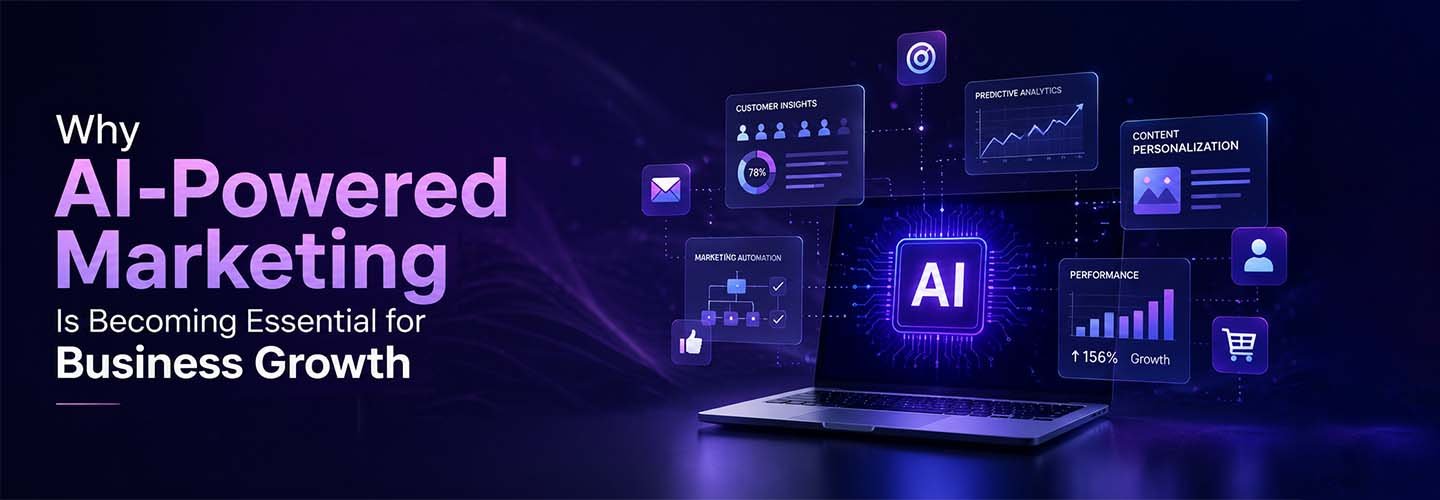
AI-powered marketing is no longer a future trend. It is already changing the way businesses plan, promote, sell and grow.
Earlier, most customers discovered brands through Google search, social media, referrals or ads. Today, the behaviour is shifting. People are also asking AI platforms for suggestions, comparisons, recommendations and answers. They are using platforms like ChatGPT, Gemini, Meta AI and other AI-driven tools to understand which brand, service, product or solution is right for them.
This is why businesses need to think beyond traditional marketing. SEO, social media, paid ads and content are still important, but now they also need to be planned with AI search, answer engines and smarter decision-making in mind.
For growing businesses, AI-powered marketing can help in content planning, SEO research, competitor analysis, performance marketing, automation, lead generation and campaign decisions. But AI is not magic, and it is not a replacement for human thinking. It works best when it is combined with strategy, creativity, experience and a clear understanding of the brand.
What Is AI-Powered Marketing?
AI-powered marketing means using artificial intelligence to make marketing faster, sharper and more data-driven.
It can help businesses understand customer behaviour, identify trends, plan content, analyse campaigns, automate repetitive work and improve lead generation. It can also support SEO, social media, paid campaigns, website experience and customer communication.
For example, a business can use AI to study which keywords people are searching for, what competitors are writing, which ad creatives are performing better, which audience is responding, and which content topics can bring better traffic or leads.
But the final direction still needs human judgement. AI can support marketing, but it cannot fully understand brand emotion, business context, customer psychology and market positioning the way an experienced marketing team can.
Why AI Marketing Is Becoming Important for Businesses
The biggest reason AI marketing is becoming important is the change in customer behaviour.
People are not only typing keywords into Google. They are asking complete questions on AI platforms. They want direct answers. They want recommendations. They want comparison-based information. This means businesses need to create content and digital assets that are clear, useful, structured and easy for both search engines and AI platforms to understand.
AI-powered marketing helps businesses in three major ways:
First, it improves speed. Teams can research faster, plan faster and execute faster.
Second, it improves decision-making. AI can help analyse data from websites, social media, ads, SEO and customer behaviour.
Third, it improves targeting. Businesses can understand who their audience is, what they are looking for and what type of messaging can influence them.
This is where AI marketing services, AI marketing strategies and AI-powered lead generation become useful for both B2B and B2C businesses.
AI Search Is Changing SEO
SEO is no longer only about ranking on Google. Businesses now need to prepare for AI search as well.
When people ask AI tools for recommendations, the platform looks for clear, trusted and well-structured information. That means brands need to focus on original content, strong website structure, FAQs, product/service clarity, authority, reviews, topical relevance and consistent digital presence.
This is where AEO, or Answer Engine Optimisation, becomes important. AEO focuses on creating content that answers user questions clearly. It helps a brand become easier to understand, easier to recommend and easier to discover across AI-driven search experiences.
For example, instead of only targeting a keyword like “digital marketing agency,” a business may also need to answer questions like:
- What does a digital marketing agency do?
- How can a digital agency generate quality leads?
- How does AI help in performance marketing?
- Which digital marketing services are useful for small businesses?
- How can SEO and paid ads work together?
These types of answers help both users and AI platforms understand the brand better.
How AI Supports Marketing Strategy
AI can support marketing strategy by helping teams move from guesswork to insight-led decisions.
Many businesses look only at numbers such as impressions, clicks, leads or cost per lead. But numbers alone do not tell the full story. A business also needs to understand what those numbers mean.
AI can help identify patterns such as:
- Which campaigns are bringing better leads
- Which audience segment is more responsive
- Which content topics are working
- Which landing pages are weak
- Which keywords have better intent
- Which competitors are gaining visibility
- Which ad creatives are getting attention
- Which channel is contributing to the buyer journey
This helps brands make better decisions. Instead of simply running campaigns, businesses can understand their audience, improve messaging and build a stronger growth strategy.
AI in Lead Generation
AI-powered lead generation is not only about getting more enquiries. It is about improving the quality of enquiries.
A lead has value only when it has the possibility to convert into business. This is why understanding the target audience is very important. AI can support this by analysing website behaviour, social media engagement, ad performance, keyword data and customer interactions.
For example, if a campaign is generating many leads but very few are converting, AI-led analysis can help identify possible issues. Maybe the audience is too broad. Maybe the message is not clear. Maybe the landing page is weak. Maybe the sales team needs better lead qualification. Maybe the offer is attracting the wrong people.
This kind of analysis helps businesses improve the entire marketing funnel, not just the campaign.
AI in Performance Marketing
Performance marketing becomes stronger when decisions are based on data and not assumptions.
AI can help marketers understand which campaign, audience, creative, placement or message is delivering better results. It can also support budget allocation, creative testing, audience insights and campaign optimisation.
For businesses, this means better control over marketing spends. Instead of only asking how many leads were generated, businesses can also understand:
- Who is engaging with the campaign?
- Which segment is showing intent?
- Which creative is creating trust?
- Which platform is giving better quality?
- Which landing page is converting better?
- Which lead source is giving better ROI?
This makes performance marketing more meaningful.
AI in Content Creation
AI can be useful for content creation, but it should be used carefully.
A common mistake many businesses make is copying AI-generated content directly and publishing it on websites, blogs or social media. This usually makes the content generic. It does not carry the brand’s voice, real experience or unique point of view.
AI should be used for research, structure, topic ideas, outlines, editing support and productivity. But the final content should be written, refined and reviewed by humans.
Good content still needs:
- Original thinking
- Brand understanding
- Market knowledge
- Customer insight
- Simple language
- Real examples
- Clear messaging
- Human tone
AI can make content faster. Human strategy makes it meaningful.
AI in Social Media Marketing
Social media is not just about posting regularly. It is about building trust, attention and recall.
AI can help with content calendars, trend research, caption ideas, competitor review, reel concepts and performance analysis. But businesses should not depend only on AI-generated visuals and generic captions.
People connect more with real content. Real teams, real customers, real work, real locations, real experiences and real stories create stronger trust than artificial-looking content.
AI can support social media planning, but authentic brand communication still matters the most.
AI in Startups and Growing Businesses
AI is especially useful for startups and fast-growing companies because it can save time and improve execution.
Startups can use AI for:
- Content planning
- SEO research
- Social media ideas
- Website copy support
- Market research
- Competitor analysis
- Customer communication
- HRMS and internal systems
- Automation of repetitive tasks
- Lead qualification
- Sales email support
- Reporting and analysis
However, startups should not use AI only for speed. They should use it to make better decisions. The right use of AI can help a startup understand its audience faster, build sharper messaging and reduce unnecessary manual work.
Useful AI Tools for Marketing in 2026
There are many AI tools that can support marketing teams. The right tool depends on the task, team size and business objective.
Some useful AI marketing tools include:
- ChatGPT for content ideas, planning, research support and marketing drafts.
- Claude for writing, strategy and detailed marketing tasks.
- Gemini for research, image support and Google ecosystem use cases.
- Canva for quick design and video creation.
- Surfer SEO for content optimisation.
- Jasper AI for copywriting support.
- Notion AI for productivity and documentation.
- Gumloop for agentic AI automations.
- v0 for website and interface building support.
- Google Labs for trying free AI tools.
- Kling AI for AI video generation.
- Lexica Art for image and thumbnail inspiration.
- LALAL.AI for audio-related tasks.
- Crayo for short-form video support.
- Brandwell for SEO blog content workflows.
- Originality AI for AI content detection.
- Writer.com for team-based content writing.
- ContentShake AI for SEO blog writing.
- FullStory for digital experience insights.
- Zapier for automation.
- Hemingway App for improving readability.
- Chatfuel for chatbots.
- Grammarly for editing and grammar checks.
- Albert.ai for digital advertising.
- Paradigm AI for data research.
- Userbot.ai for conversation management.
- Browse AI for web-page scraping.
- Algolia for search and recommendation APIs.
- PhotoRoom for background removal.
- Reply.io’s AI Sales Email Assistant for email reply support.
- Brand24 for media monitoring.
- Influencity for influencer marketing.
These tools can improve productivity, but they should be used with a clear strategy. Tools alone do not create business growth. The real value comes from knowing where, why and how to use them.
Why Human Strategy Still Matters
AI can analyse, suggest and automate, but it cannot fully replace human experience.
A strong marketing strategy still needs human understanding of:
- Brand positioning
- Buyer journey
- Customer emotion
- Market competition
- Business goals
- Sales process
- Creative direction
- Communication tone
- Trust-building
- Revenue impact
This is why the best marketing approach is not AI versus humans. It is AI with humans.
AI helps teams work faster. Human intelligence helps teams work in the right direction.
How Businesses Can Prepare for AI-Powered Marketing
Businesses that want to prepare for AI-powered marketing should start with the basics.
They should make sure their website has original content, clear service pages, strong FAQs, structured information and proper SEO. They should build content around customer questions and not only around keywords.
They should also keep their social media active, improve their Google Business Profile, collect reviews, build trust signals, and track campaign data properly.
Most importantly, they should use AI for decision-making. If a business is running ads, posting content and doing SEO without understanding the audience, it will not get the best results. AI can help connect insights across different platforms and show what needs to improve.
Conclusion
AI-powered marketing is becoming essential because the way people search, compare and make decisions is changing.
Businesses can no longer depend only on traditional marketing strategies. They need to think about AI search, SEO, AEO, content, performance marketing, automation, lead generation and customer behaviour together.
AI can help businesses work faster, understand data better, improve campaigns and generate better leads. But it should not be used blindly. Copy-paste AI content, generic visuals and tool-based marketing without strategy will not build a strong brand.
The right approach is to combine AI tools with human creativity, strategic thinking and business understanding.
For businesses that want to grow in the new digital environment, AI-powered marketing is not optional anymore. It is becoming a core part of business growth.